
Talent: An Excuse to Cope with the Success of Others
At a fundamental level, calling someone 'talented' turns superior performance or achievement into an exception rather than the result of effort. Something to be admired rather than something to learn from.
"Hard work is a prison sentence only if it does not have a meaning." (Gladwell, 150: 2008)
You know that itching frustration of sitting in the cinema and hearing only loud chewing or the rustling of snacks, a rhythm that beats out of sync with the film. It is a deeply irritating sound you don't speak about, bury deep inside, only to complain about afterwards. For me, hearing the word talent evokes the same reaction. The context doesn't matter: a job listing, an internship programme, a government strategy for developing graduates, or a way to acknowledge an individual achievement. Each time I read or hear talent, my mind drifts into frustration and distraction, like the loud eater in the cinema.
Semantic? Perhaps.
The irritation, however, is not about the choice of vocabulary. It is about the unspoken culture this word quietly helps sustain every time it is used, and that is why it matters here: because the real issue is how it shapes what we value and reward.
Background: My Relationship with Talent
Before I found myself in the frame-by-frame world of animation, before I completed a PhD, and before I ventured into academia and Virtual Production as a postdoctoral researcher, I was heavily involved in sport. That matters here because my doctoral thesis focused on the similarities between training in sporting environments and developing animation practice. Those similarities were not surface level overlaps, but deeper ones: purposeful practice, a mindset robust enough to navigate iterative failure, and an environment that reframes that failure into progressive development. The overlap between creative fields and sport requires, in both individual mindset and structured training, more than most conversations about either field acknowledge.
In both fields, one word continued to haunt my every move: talent.
Malcolm Gladwell writes about our cultural responses to achievements, stating that,
"We are so caught up in the myths of the best and brightest and the self-made that we think outliers sting naturally from the earth." (Gladwell, 2008:268)
We become so obsessed with others' success that we strip away the complexity of their journeys and the pathways to those achievements. So, before we get into why this attitude and word can cause problems, it is worth reflecting on something more fundamental: what does talent actually mean in this context?
A Definition Steeped in Ambiguity
Ask yourself, before reading further, what you mean when you use the word talent. We have all used it; despite my rhetoric, I have used the word too. But what do you mean by it?
Push the question further. When you describe someone as 'talented', what exactly are you describing? Is it simply an individual's achievement, or are you commenting on a difference you observe when comparing yourself? Is it a narrative used to explain why an individual did something?
The distinction between observation and explanation is fundamental. 'Talent' describes a difference we've noticed. It very rarely explains how that difference came to exist, and the moment a description is mistaken for an explanation, the damage is done. That affects how we train people, how we select individuals for programmes, and how individuals frame their own development. In turn, it shapes the culture of the environment.
'Talent', depending on the sector or the academic article cited, has many definitions. To be respectful of any academic article or thought piece on how to best 'manage talent', they are not the focus here. In practice, day to day, we all use the word and, in doing so, risk misrepresenting the development journey an individual takes to achieve something. It becomes cyclic.
How do you know someone is talented? Because of the high performance. Why did they perform to such a level? Because they are talented...
The Invisibility of Developing Skill
Developing any skill, whether improving sporting performance or animation, requires motivation and dedication to the craft. There is a lot of writing about intrinsic and extrinsic motivation, and without oversimplifying the differences, intrinsic goal setting generally leads to stronger motivation, persistence, and performance.
'Although people often pursue extrinsic goals because they hope to "buy" their happiness by doing so, self-determination theory maintains, rather paradoxically, that extrinsic goal pursuit will be associated with poorer well-being and adjustment compared to intrinsic goal pursuit.' (Hagger and Chatzisarantis, 2007)
In other words, when motivation is linked to outcomes and recognition by others, performance and development are generally negatively affected. So, let's return to the idea of 'talent' and Gladwell's observations about our collective obsession with people who seem naturally gifted. Creating a culture that praises 'talent' or seeks new 'talent' creates an interdependency in which we reward a perceived outcome of success. At the same time, individuals strive for recognition that they are gifted. Pair this cultural aspect with the warped reality and performative output of Social Media, combined with unhealthy relationships with technology, for example, and you get a challenging development environment for anyone trying to improve. This is why Social Media, technology and other creative inhibitors remain relevant here; they intensify the same pressure.
More intrigue and mythos are cemented in the idea of the gifted. Cultural admiration is heightened when a successful outcome or achievement is made to look effortless. The problem is that the hours of work then become invisible. Experience becomes less important. The failed iterations that led to success are hidden. Everything is stripped away to the notion of giftedness, and the evidence of development disappears.
This is more exaggerated in creative fields than in sport. The biggest difference between sport and animation in this example is that effort and training in high-level sport are not invisible. The outcomes of hard work are clear. So, if you watch an athlete described as 'talented' or 'gifted', you can spot recognisable traits that point to hard work, whether they are in optimum physical shape or their size and shape suggest their ability. Michael Phelps's wingspan is an example of genetic advantage on top of an elite mindset and approach to training. In animation and VFX, hard work is invisible because creating suspension of disbelief requires hiding it, so the audience believes what they are watching on screen is alive. The expertise and failed iterations are hidden in the on-screen outcome.
You pair this invisible effort with an environment that craves innate ability, and you create barriers that weaken the mindset needed to develop creative skills, whether in animation or wider creative spaces.
Development Environments
An environment for training any skill is crucial to ensure individuals reach their potential and perform at a high level at the right moment. Sport understands this. During my PhD, I explored the work of Kristoffer Henriksen, Natalia Stambulova, and Kirsten Kaya Roessler, who examine the overall environment shaping athletes in Denmark and position stakeholders within a working model of a development environment. These areas, direct and indirect, include the national culture they grow up in, the culture of the specific sport they train in, and the broader sports culture nationwide. Each section affects individual development.
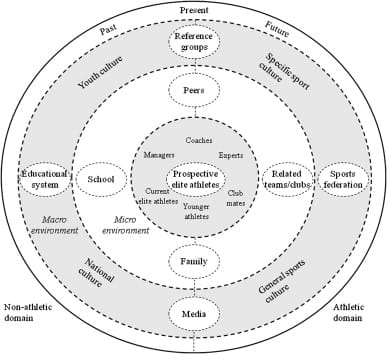
As you can see from the model above, it includes more than the physical spaces an individual engages with; it also includes broader culture. That culture can be the sport they play or the country they were born in. It is also the relationships built with different stakeholders within those physical spaces. All these incremental details, which may feel inconsequential on their own, matter when viewed as a whole because they shape development.
This approach is where animation and the wider creative sectors could learn from sport and dig deeper into the environments created for individuals trying to improve their skill set and enter the industry. This became particularly clear to me recently when I joined a panel at IBC in Amsterdam on Building Europe's Next Generation of Media Innovators. The discussion brought together concerns often separated in policy and industry conversations: cities, broadcasters, universities, research-and-development networks, startups, and the wider media ecosystem. The panel's premise was not merely how to identify the next group of innovators, but what they need to test ideas, develop skills, find collaborators, and build sustainable careers and companies in a changing media landscape.
The discussion repeatedly returned to environment and place. Not place in the narrow sense of a building or geographical location, but place as an ecosystem: a set of relationships between learning, experimentation, employment, research, culture, technology and opportunity. This is a more demanding way to think about innovation because it asks us to examine the conditions that allow a person to move from interest to experimentation, to practice, to contribution. So, for this provocation, let's focus on culture, because it shapes those conditions.
From 'talent' to Responsibility.
Removing language such as 'talent' makes us more precise about the skills required in any creative industry. It demands greater clarity about responsibilities from both organisations and structures looking for the next generation, and it gives individuals more agency to manage their own development. In this way, the language itself becomes more responsible, shifting attention from labels to conditions, responsibilities, and development.
If ability is not treated as a fixed and mysterious gift, then development becomes something a person can participate in deliberately. They can identify the skills they need, seek feedback, practise with intention, reflect on setbacks, recognise where they need support, and choose the kind of practitioner they want to become. Agency becomes possible because the route is no longer framed as waiting to be recognised as naturally gifted. It becomes a process of engaging with challenge, building capability and using the opportunities available within an environment.
This matters because the word talent can quietly produce fatalism. Someone who is praised as talented may feel pressure to appear effortless, as though struggle might expose them as undeserving of the label. Someone not given the label may assume they do not belong, even when they have the curiosity, commitment, and capacity to develop. Both positions can restrict learning. One protects an image of natural ease; the other internalises exclusion.
A culture focused on development makes a different promise. It says ability matters, effort matters, and standards matter, but none of these is fixed at the point of entry. It says that people are expected to take ownership of their progress, while also being entitled to clear information, credible support, fair access and opportunities to learn through real practice.
Conclusion: From the Individual to the Environment
At a fundamental level, calling someone 'talented' turns superior performance or achievement into an exception rather than the result of effort. Something to be admired rather than something to learn from. Relating to the title of this post, it also becomes an acceptable reason why someone else has reached their goals, and you perhaps have not. A coping mechanism. It is okay if you did not achieve the same success; they are just 'born to be an animator'.
I do not mean to be provocative there; I have done it, looking for reasons elsewhere rather than looking at myself and reflecting on what I can improve. 'Talent' obscures the work that went into the outcome. A high-performance environment; whether sporting, creative or technical, should instead make development visible. It should value effort, reflection, feedback and sustained practice, while providing clear support and challenge. That places responsibility on the environment to create meaningful routes for development, but also on the individual to engage with those routes, identify what they need to learn and take agency over their progress.
The aim is not to deny differences in people. It is to reject the myth that achievement is simply an innate gift. A culture of responsibility asks not, "Who is talented?" but: "What work, support and conditions will enable people to develop?"
I'll close with a line I came across while writing my PhD, aimed originally at athletes. However, I think it applies just as well to animators, VFX artists and anyone else being quietly sorted into "talented" and "not talented enough":
"the finished article is not born; it must be developed and maintained. For many performers, failings are not physical or technical, but mental. It is important they recognise and understand this" (Sheard, 2012)
Thank you for taking the time to read this blog entry. This is one half of a conversation; please comment, reach out, and I am always interested in hearing how others are navigating this creative landscape we are in. Creative Frictions is an ongoing series where I wrestle with and explore the environments that shape our creative work and development. .
Bibliography and Reading List
Barbouta, A., Barbouta, C. and Kotrotsiou, S. (2020) “Growth Mindset and Grit: How Do University Students’ Mindsets and Grit Affect their Academic Achievement?,” International journal of caring sciences, 13(1), pp. 654–664.
Dweck, C.S. (2017) Mindset. Updated edition. London: Robinson.
Gladwell, M. (2009) Outliers : the story of success. London: Penguin Books.
Hagger, M. and Chatzisarantis, N. (2007) Intrinsic motivation and self-determination in exercise and sport. Champaign, IL: Human Kinetics.
Henriksen, K., Stambulova, N. and Roessler, K.K. (2010) “Holistic approach to athletic talent development environments: A successful sailing milieu,” Psychology of sport and exercise
Mathorne, O. et al. (2021) “Shared Features of Successful Interorganizational Collaboration to Promote Local Talent Development Environments in Denmark,” Scandinavian Journal of Sport and Exercise Psychology, 3, pp. 2–12.
Roy, M.M. et al. (2024) “The naturalness bias in sport,” Psychology of sport and exercise
Sheard, M. (2013) Mental toughness the mindset behind sporting achievement. Second edition. Hove, East Sussex: Routledge.
Syed, M. (2016) Black box thinking : marginal gains and the secrets of high performance. London: John Murray.
Wells, P. and Moore, S. (2015) The fundamentals of animation. Second edition / Paul Wells and Samantha Moore. London: Fairchild Books, an imprint of Bloomsbury Publishing Plc.